
AI in Law Firms: What It Means for Remote Legal Teams in 2026
AI in law firms is no longer a future-facing topic. It is already changing how legal work is researched, drafted, reviewed, and delivered. In fact, 79% of legal professionals now report using artificial intelligence in their firms, showing just how quickly adoption has moved into the mainstream. The more useful question in 2026 is not whether firms will adopt AI, but how that adoption should reshape team structure, workflow design, and remote legal support. Done well, AI can accelerate routine work and reduce cognitive load. Done poorly, it can create quality risks, unclear ownership, and process confusion. That is why remote legal teams matter more, not less, as firms adopt AI.
AI Is Changing Legal Work, Not Eliminating Legal Teams
The strongest firms are not treating AI as a replacement for legal professionals. They are using it to speed up repetitive work, improve responsiveness, and create more capacity for higher-value tasks. Thomson Reuters reports that AI is already being used across routine legal work and may save legal professionals nearly 240 hours per year.
That shift does not remove the need for people. It changes where people add value. As AI takes on more first-pass work, firms still need human judgment for review, prioritization, escalation, client communication, and quality control. This is also why the fundamentals of building a high-performing legal team become even more important in AI-enabled environments.
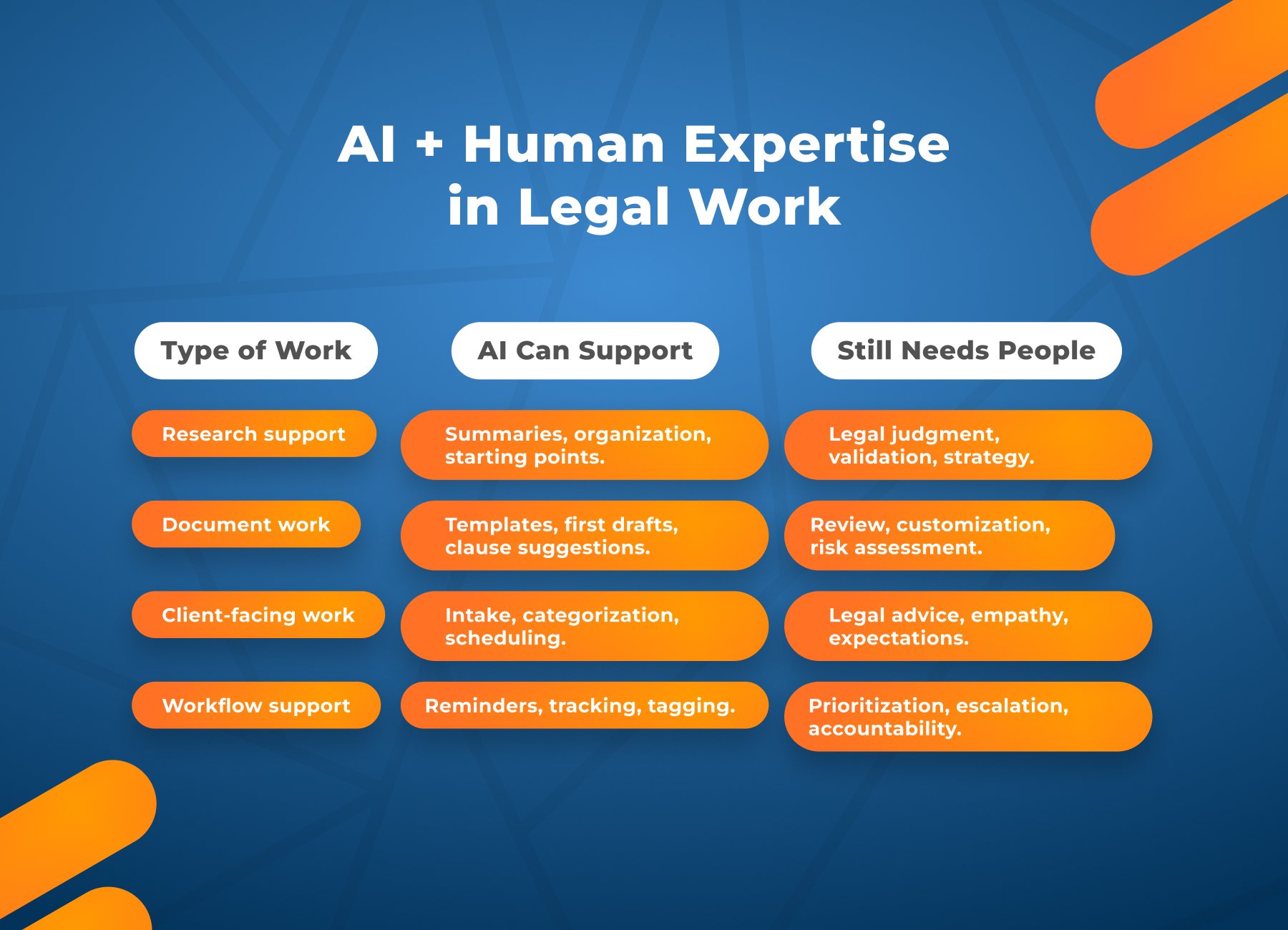
What AI Can Speed Up, And What Still Needs People
AI can support many legal workflows, but not all work should be delegated equally. A clearer operating model helps firms avoid both overreliance and underuse.
This distinction matters because legal professionals themselves continue to insist on human oversight. 96% of legal professionals believe letting AI represent clients in court would go too far, and 83% believe using AI to provide legal advice would also be inappropriate.
Why Remote Legal Teams Become More Valuable as AI Adoption Grows
The real mistake is thinking AI reduces the importance of support roles. In practice, AI increases the value of remote legal teams that can keep work moving cleanly and consistently.
As law firms adopt AI, remote legal teams become more valuable for:
Reviewing and organizing AI-assisted outputs.
Maintaining documentation discipline.
Coordinating matters and handoffs.
Managing intake and follow-up.
Escalating questions that require legal judgment.
Keeping client communication timely and structured.
That is the more useful lens for 2026. Remote legal teams are not just there to “double-check the machine.” They help firms turn AI-enabled speed into reliable execution.
What Law Firms Get Wrong About AI Adoption
A lot of firms are not struggling because the tools are weak. They are struggling because the operating model is unfinished.
Common mistakes include:
Adopting AI before defining review standards.
Assuming time savings automatically reduce the need for support staff.
Treating AI as a staffing replacement instead of a workflow tool.
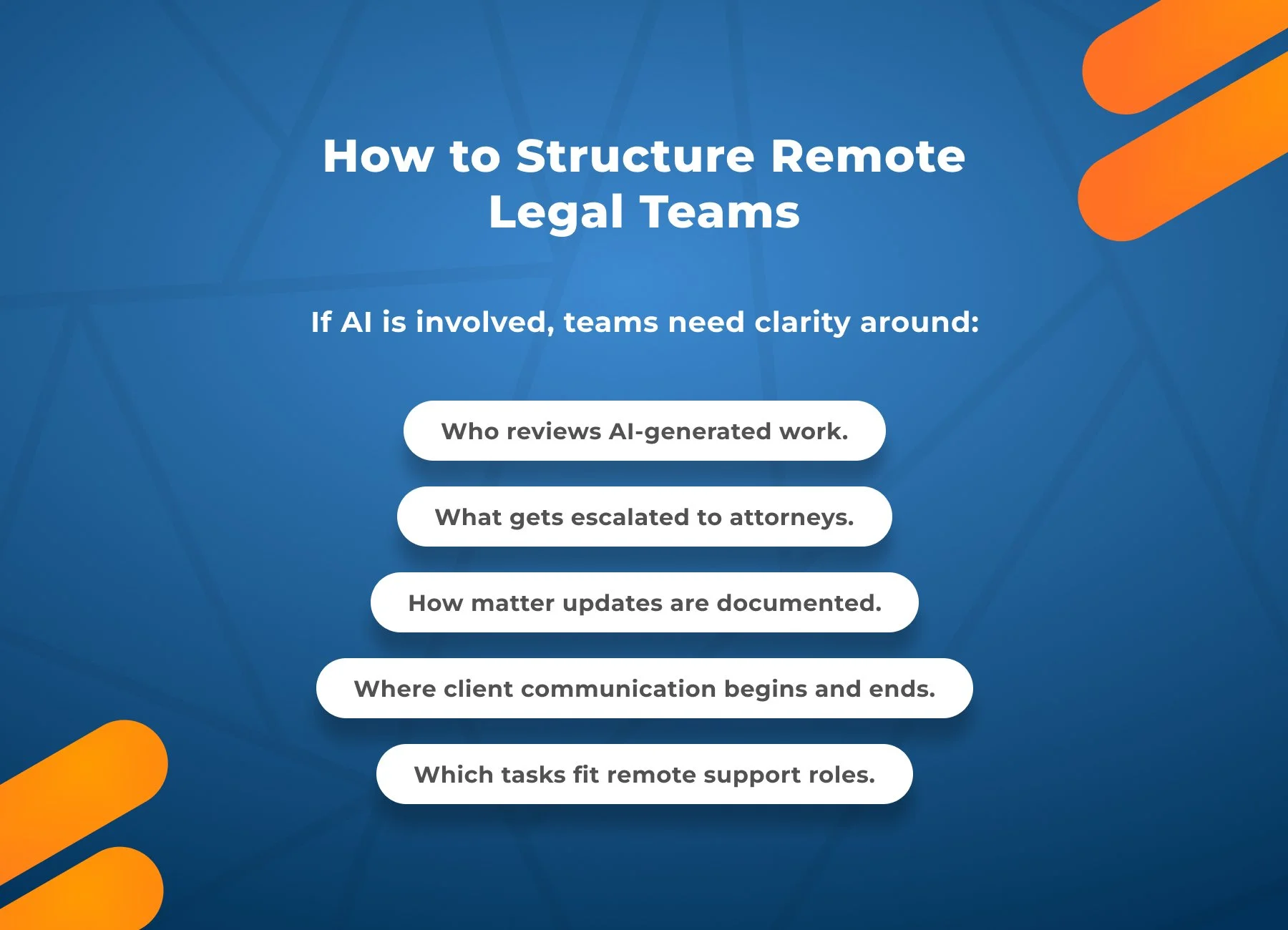
Failing to assign ownership for output validation.
Introducing new tools without clarifying client communication boundaries.
AI is not only a productivity tool, but also a catalyst for business-process reengineering inside firms. In that context, “this is how we have always done it” is no longer a workable assumption. Harvard also notes that AI is forcing firms to reexamine long-standing business processes and even the dominant billable-hour model. That is what makes this topic bigger than legal tech. It is really about legal team design.
How Projective Staffing Helps
We help law firms build remote support teams that fit the realities of modern legal operations. That includes remote legal professionals who can support intake, documentation, coordination, communication, and workflow continuity in AI-enabled environments.
We help firms hire with more structure by focusing on:
Communication fit.
Workflow readiness.
Autonomy and accountability.
Long-term role alignment.
For firms thinking beyond one-off hires, long-term staffing partnerships can create more consistency as legal operations evolve.
Frequently Asked Questions
How is AI changing law firms in 2026?
AI is speeding up routine legal work, increasing pressure on older billing models, and forcing firms to rethink how legal work is assigned, reviewed, and delivered.
Can AI replace remote legal staff?
Not effectively. AI can assist with research, drafting, and workflow support, but firms still need people for review, escalation, client communication, and process consistency.
Why are remote legal teams important in AI-enabled firms?
Because faster workflows still need coordination, quality control, documentation discipline, and clear communication. Remote legal teams help firms turn AI-assisted speed into reliable delivery.
Build an AI-Ready Legal Team
The firms that benefit most from AI will not be the ones with the most tools. They will be the ones with the clearest workflows, the strongest review standards, and the right people supporting the system.
If your firm is adopting AI and needs remote legal talent that can support modern workflows with more clarity and less friction, we help you build the team behind that transition. Schedule a consultation.