
The Interview Question Most Companies Forgot to Ask
Most interviews still run on the same script: walk me through your resume, tell me about your experience, describe your background. None of those are bad questions. But none of them ask what actually matters — can this person do the job, and how do we know. Somewhere along the way, interviews drifted from testing capability to confirming credentials, and the two aren't the same thing.
What Most Interviews Actually Measure
A typical interview spends most of its time verifying what's already on the resume. Where did you work, what was your title, how long were you there. That's confirmation, not evaluation. It tells you the candidate held a job. It doesn't tell you whether they were good at it, how they handled the parts that didn't go according to plan, or whether their judgment holds up under real conditions.
This isn't a minor gap. According to McKinsey's research on skills-based hiring, organizations that evaluate candidates on demonstrated skills see meaningfully lower turnover in those hiring cohorts than organizations that rely on credentials alone. The people who stay are the ones whose actual capability was tested before the offer went out, not just their resume.
The Research on What Predicts Performance
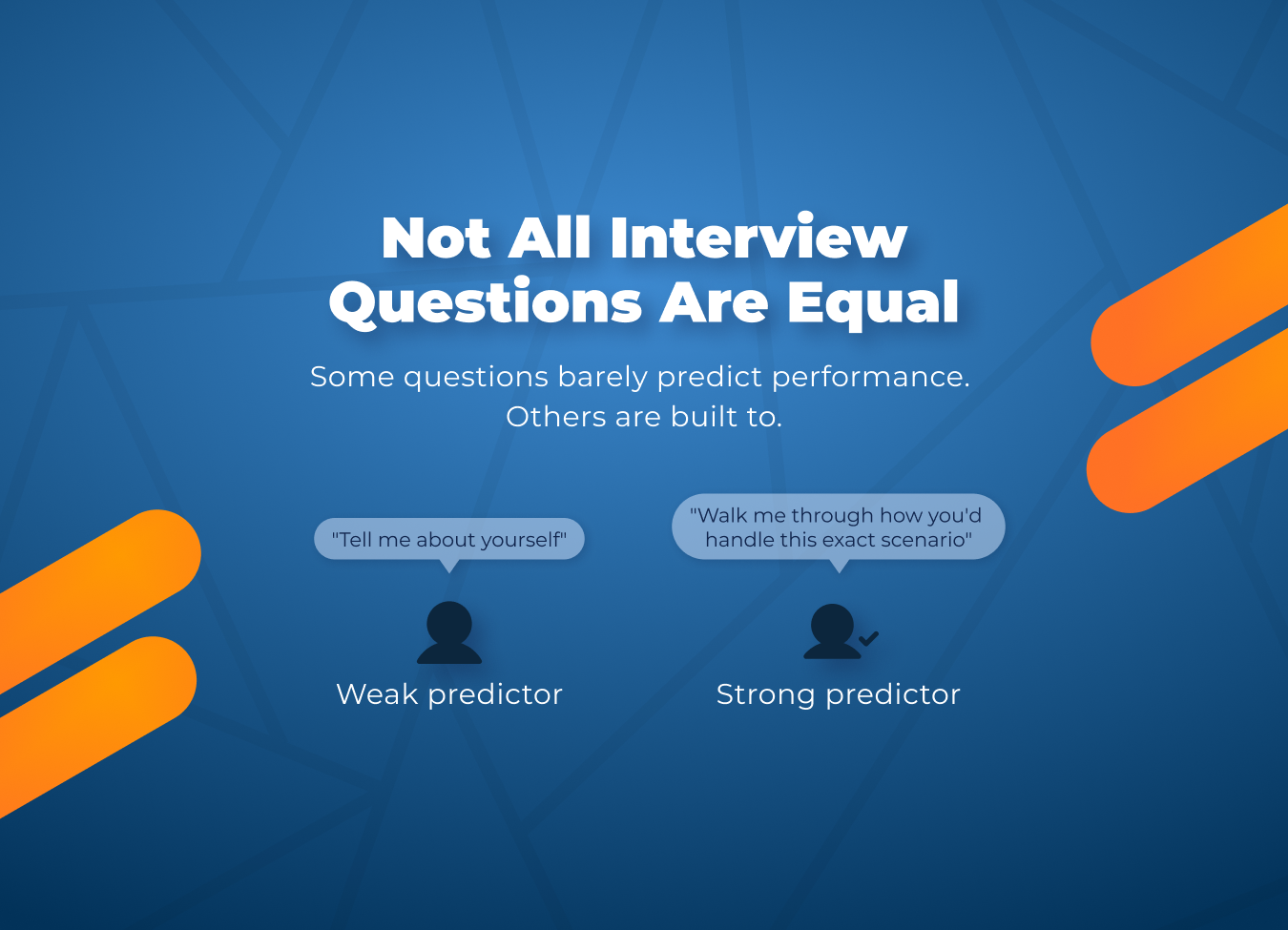
The evidence here isn't new, but most interview formats haven't caught up to it. Unstructured, conversational interviews — the kind built around "tell me about yourself" and open-ended background questions — are among the weakest predictors of job performance available. Structured interviews, where every candidate answers the same job-relevant questions and gets scored against a consistent rubric, perform substantially better.
The shift toward skills-based evaluation reflects this. SHRM's research on skills assessment points to the same conclusion many talent leaders have reached independently: credentials and years of experience are convenient filters, but they're weak signals of how someone will actually perform in a specific role. The gap between what companies screen for and what predicts success is exactly where good candidates get lost and weak ones get through.
The Question Most Interviews Skip
The question that gets left out, more often than not, is some version of: show me how you'd handle this, specifically. Not a hypothetical about their philosophy on teamwork. Not a rehearsed story about a challenge they overcame. A real scenario tied to the actual job, with enough specificity that a generic answer can't survive it.
That single shift changes what an interview measures. Instead of asking a candidate to describe their experience, you're asking them to demonstrate their thinking. Instead of confirming what's on the resume, you're testing what isn't visible on paper at all — judgment, problem-solving under ambiguity, how they prioritize when something breaks.
If your company has been growing quickly and hiring under pressure, this is often where interview quality slips first. Our piece on signs you're ready to grow covers the broader pattern of hiring processes that scale in volume before they scale in rigor.
What a Capability-Based Interview Looks Like in Practice
A stronger interview structure isn't more complicated — it's more specific. A few adjustments make the difference:
Replace generic behavioral prompts with scenario-based questions drawn directly from the role's real challenges. Score every candidate against the same criteria, not a general impression. Ask for specifics when an answer stays vague — what exactly did you do, what happened next, what would you do differently.
This is also where a recruiting partner earns its keep. Building and running a consistent, capability-based interview process takes structure most internal teams don't have time to build role by role. Our breakdown of what a professional recruiter really brings to your hiring strategy covers how that structure gets built and maintained across roles.
Frequently Asked Questions
Why do unstructured interviews predict job performance poorly?
Unstructured interviews vary from candidate to candidate, rely heavily on interviewer impression, and rarely test how someone actually performs the tasks the role requires.
What makes a question a good predictor of job performance?
Questions tied directly to real, role-specific scenarios that require candidates to demonstrate judgment and problem-solving, rather than describe past experience in general terms.
Is skills-based interviewing the same as skills-based hiring?
They're related. Skills-based hiring is the broader strategy of prioritizing demonstrated ability over credentials; skills-based interviewing is one of the tools used to evaluate that ability directly.
Can a staffing partner help build a stronger interview process?
Yes. A staffing partner familiar with structured, capability-based interviewing can help design consistent questions and scoring criteria, then apply that same rigor to every candidate presented.
Build a Hiring Process That Supports Growth
Better hires don't come from longer interviews — they come from sharper ones. Projective Staffing brings structured, capability-focused evaluation to every candidate we present, whether you're building a remote team or hiring direct. Learn more about our long-term staffing partnerships and how that rigor shows up in every hire. Interested in talking? Schedule a consultation.