
The Human Skills AI Cannot Replace in Remote Teams
Human skills AI cannot replace are becoming more valuable as remote teams adopt more automation. AI can summarize meetings, draft content, organize information, and support faster workflows, but it cannot fully replace judgment, trust, ownership, or contextual communication. For companies building remote teams in 2026, the strongest strategy is not choosing between AI and people. It is hiring remote professionals who can use AI well while bringing the human skills that keep distributed work aligned, accountable, and effective.
AI Can Support Remote Work, But People Still Drive Performance
AI is changing how remote teams operate. It can reduce repetitive work, speed up research, improve documentation, and help teams manage information across time zones.
But remote performance still depends on people who can interpret context, make decisions, communicate clearly, and build trust without being in the same room.
The World Economic Forum’s 2025 skills outlook identifies analytical thinking, resilience, flexibility, agility, leadership, and social influence as critical workforce skills. Those are not just technical abilities. They are the human capabilities that help teams adapt when work becomes more complex.
What AI Changes in Remote Teams
AI gives remote teams more speed. It can help with first drafts, summaries, task organization, research, and workflow automation.
However, speed does not automatically create alignment. In remote teams, faster output can create more confusion if people do not know what matters, who owns the decision, or when something needs human review.
Microsoft’s 2025 Work Trend Index points to AI skilling, digital labor, and human-agent teams as major workforce trends. That makes human oversight even more important because teams need to know where AI supports work and where people remain accountable.
The Human Skills AI Cannot Replace
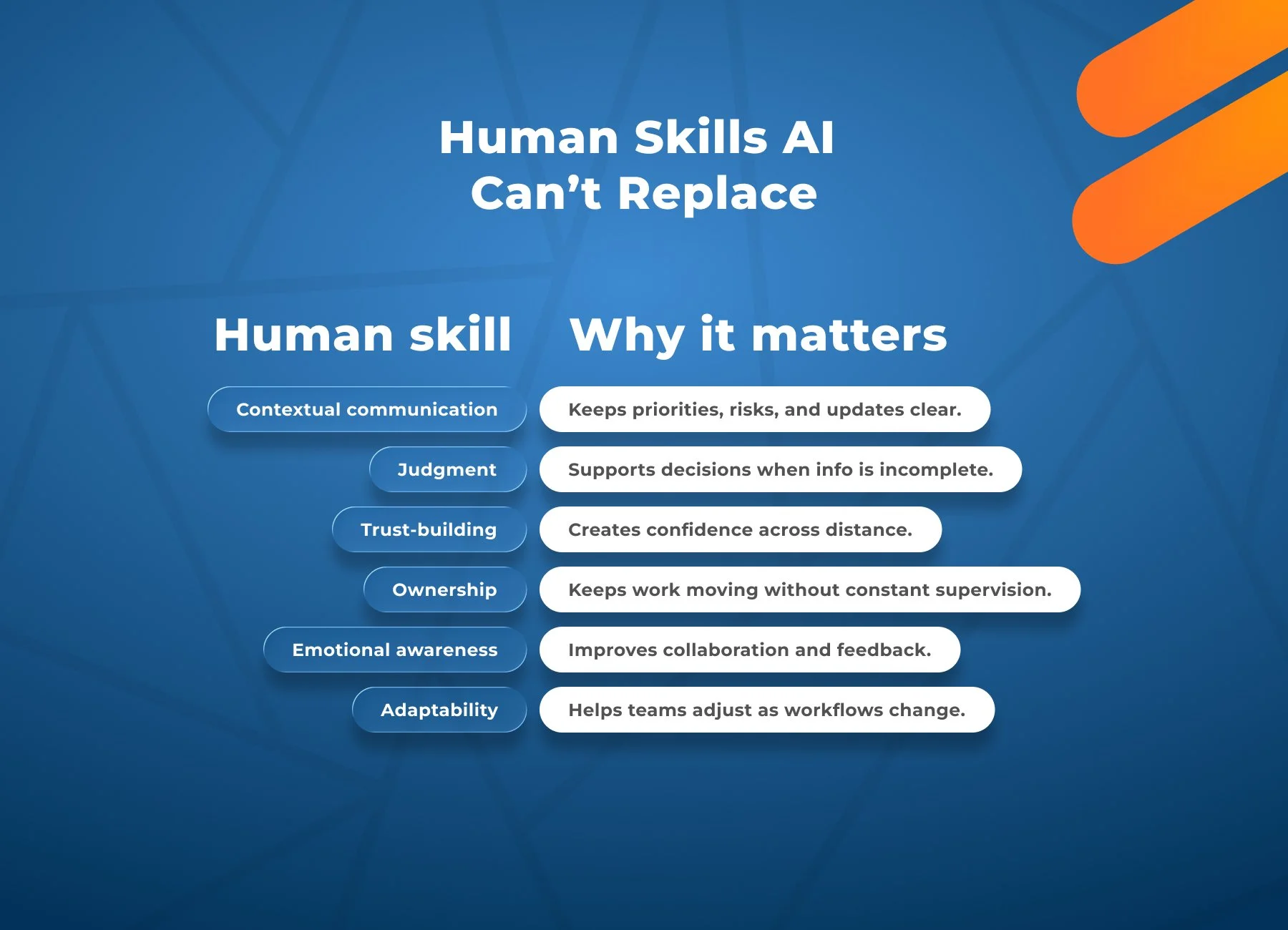
1. Contextual Communication
AI can draft a message, but it cannot always understand the full business context behind it.
Remote teams need people who know what to say, when to say it, who needs the update, and what action should happen next. Strong communicators reduce uncertainty. They explain what changed, what matters now, what decision is needed, and what risk should be watched.
This connects closely to AI in workplace communication. AI can support communication, but people still need to decide what is accurate, relevant, and useful.
2. Judgment Under Ambiguity
Judgment is one of the most important human skills AI cannot replace. AI can provide options, summaries, and recommendations, but it does not fully understand client relationships, company priorities, team capacity, or long-term consequences.
MIT Sloan research suggests AI is more likely to complement people than fully replace them, especially when work depends on judgment, leadership, empathy, and decision-making.
3. Trust-Building
Remote teams depend on trust because managers cannot rely on physical visibility to understand progress. AI cannot build trust for a team member. Trust comes from consistency, follow-through, honesty, and clear communication over time.
A trustworthy remote professional communicates delays early, asks for clarification, shares progress without being chased, and handles sensitive information carefully.
4. Ownership and Accountability
AI can help complete tasks, but ownership is broader than task completion.
Ownership means understanding the outcome, noticing problems, and taking responsibility for moving work forward. In remote teams, this matters because managers may not see every blocker in real time.
5. Emotional Awareness and Collaboration
Remote teams can experience misalignment quietly. A message may be misunderstood. Feedback may feel unclear. A delay may create tension between departments.
AI can help rewrite a message, but it cannot fully understand the relationship context behind it.
Emotional awareness helps remote professionals understand tone, timing, and impact. It supports better feedback, smoother collaboration, and stronger working relationships across distance.
6. Adaptability and Learning
AI tools will keep changing. Remote workflows will keep changing. Business needs will keep changing. Adaptable remote professionals do not need to master every tool immediately. They need the discipline to learn, adjust, and turn new technology into practical workflows.
How to Hire for Human Skills in Remote Teams
Human skills are harder to evaluate than technical experience. A resume may show what someone has done, but not how they communicate, handle ambiguity, or take ownership.
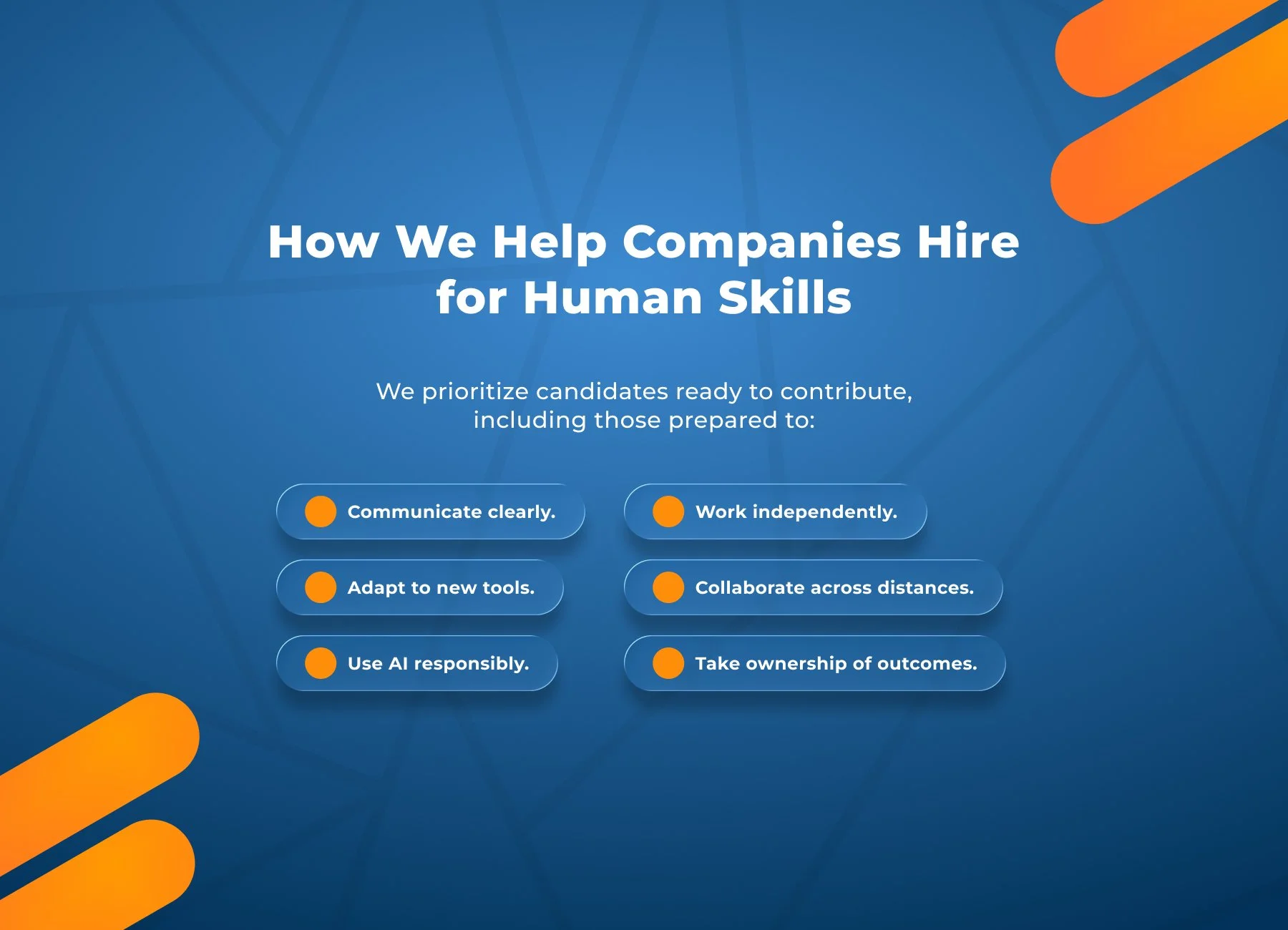
Hiring teams should look for clear written communication, examples of independent work, thoughtful questions, problem-solving under unclear conditions, and evidence of follow-through.
This is why soft skills matter more as AI becomes part of daily work.
Frequently Asked Questions
What human skills can AI not replace?
AI cannot fully replace judgment, trust-building, emotional awareness, ownership, leadership, creativity, and contextual communication.
Why do human skills matter in remote teams?
Remote teams depend on clarity, accountability, and trust. Human skills prevent misalignment and help work move forward without constant supervision.
Can AI improve remote team productivity?
Yes. AI can support summaries, documentation, research, and automation. Human oversight is still needed to verify quality and make decisions.
How should companies hire for human skills?
Companies should assess communication, problem-solving, autonomy, adaptability, and accountability through structured screening and role-specific interviews.
Build Remote Teams With the Human Advantage
AI will continue changing how remote teams work, but it will not replace the human skills that make distributed work successful. If your company is expanding its remote team, Projective Staffing can help you find professionals who bring both workflow readiness and the human skills AI cannot replace. Schedule a consultation.