
Building a Summer Staffing Coverage Plan That Doesn't Burn Out Your Team
A summer staffing coverage plan is what keeps a team functioning normally when several people are out in the same two-week window instead of one. August is when this problem peaks: vacations cluster, school schedules shift, and the people who stay behind often absorb the difference quietly, without anyone noticing until deadlines slip. A coverage plan built in advance — not assembled the week someone requests time off — is what prevents that.
Coverage Gaps Are Predictable, Which Means They're Preventable
Most staffing strain in August doesn't come from any single person being out. It comes from absences overlapping without a clear handoff plan in place. SHRM found that having no colleagues available to cover their work was one of the notable reasons employees cite for not taking time off, which points to a gap in coverage planning rather than a lack of willingness to take leave. When employees don't trust that their work will be covered, they either delay requests, take shorter trips than they'd like, or take time off and stay reachable anyway. None of those outcomes serve the business or the employee.
The fix starts earlier than most teams expect: a coverage plan should exist before the first vacation request of the summer arrives, not after the third overlapping one causes a problem.
Cross-Training Is the First Line of Defense
The most common point of failure in a coverage plan is a single person holding sole knowledge of a task, account, or process. When that person is out, the work either stalls or gets rerouted to someone unprepared for it. Cross-training closes that gap, and building strong productivity habits makes that handoff far smoother when someone steps away.
Atlassian offers a useful model here: documenting project status and key contacts in a shared, collaborative space before time off begins lets teammates ask questions and post updates asynchronously, without waiting for the person to return. A simple standard works well for most teams: for any recurring task, at least one other person should know how to do it well enough to keep things moving for a week.
When Remote Support Makes More Sense Than Stretching Your Team
Cross-training solves knowledge gaps, but it doesn't solve volume. If three people are out in the same week, redistributing their full workload across the remaining team usually means someone is doing two jobs at once — a pattern that erodes morale quickly. It can also create real payroll exposure: the U.S. Department of Labor's fact sheet on overtime pay confirms that covered, nonexempt employees must receive overtime at not less than one and one-half times their regular rate for hours worked beyond 40 in a workweek, making the Fair Labor Standards Act's overtime pay requirements a compliance issue as much as a burnout risk when coverage relies on unmanaged overtime.
For predictable, recurring coverage needs, remote support is often a better fit than internal overtime. Teams that need to hire remote talent fast for a defined coverage window can add real capacity without permanently changing headcount or asking existing staff to carry more than they can sustain. This works particularly well for administrative, coordination, and customer-facing roles where a remote professional can be onboarded quickly and given clear, bounded responsibilities.
A Simple Framework for Building the Plan
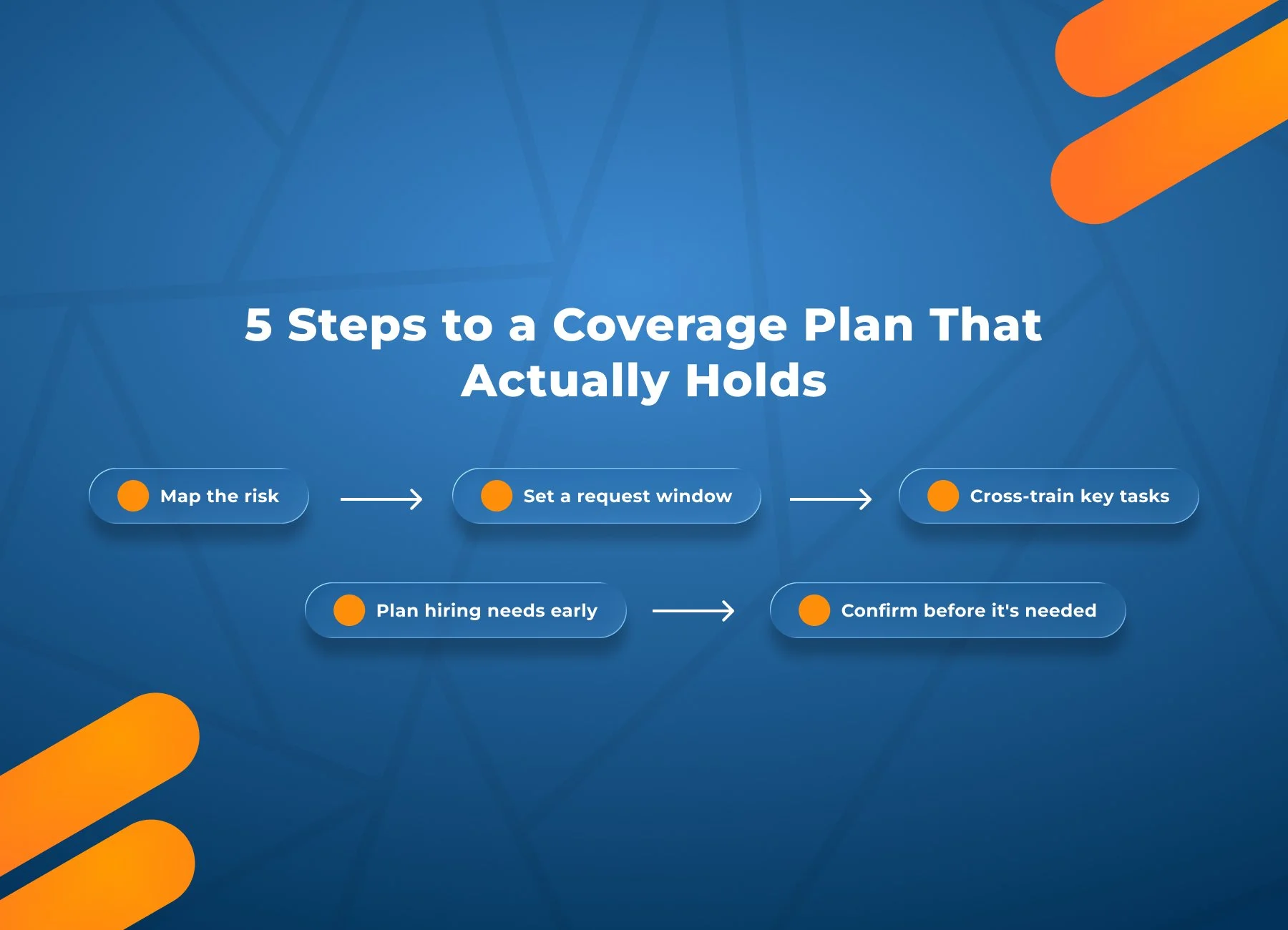
| Step | What to Do |
|---|---|
| 1. Map the risk | Identify which roles have only one person who can do them. |
| 2. Set a request window | Require PTO requests for August with enough lead time to plan around. |
| 3. Cross-train key tasks | Document processes and assign a backup for each critical function. |
| 4. Add coverage where needed | Bring in remote support for volume, not just knowledge gaps. |
| 5. Confirm before it's needed | Walk through the plan with the team before absences begin, not during them. |
A plan built this way turns August from a month leaders brace for into one they've already prepared for.
Frequently Asked Questions
How far in advance should summer PTO requests be submitted?
Two to four weeks is a reasonable standard for most teams, giving enough time to arrange cross-training or coverage without restricting employees unfairly.
Is cross-training enough to cover multiple absences at once?
It solves knowledge gaps but not volume. When several people are out at the same time, added support is usually needed alongside cross-training.
What roles benefit most from remote coverage?
Administrative, coordination, and customer-support roles tend to onboard quickly and adapt well to well-defined coverage windows.
Does a coverage plan reduce burnout risk?
Yes. Distributing absence coverage across a documented plan, rather than informally reassigning it to whoever is available, prevents the same few people from repeatedly absorbing extra work.
Build Remote Capacity Without Adding Complexity
If your team needs remote support to get through overlapping August absences, Projective Staffing can help you add capacity quickly and without overcommitting. Schedule a consultation to talk through your coverage needs.