
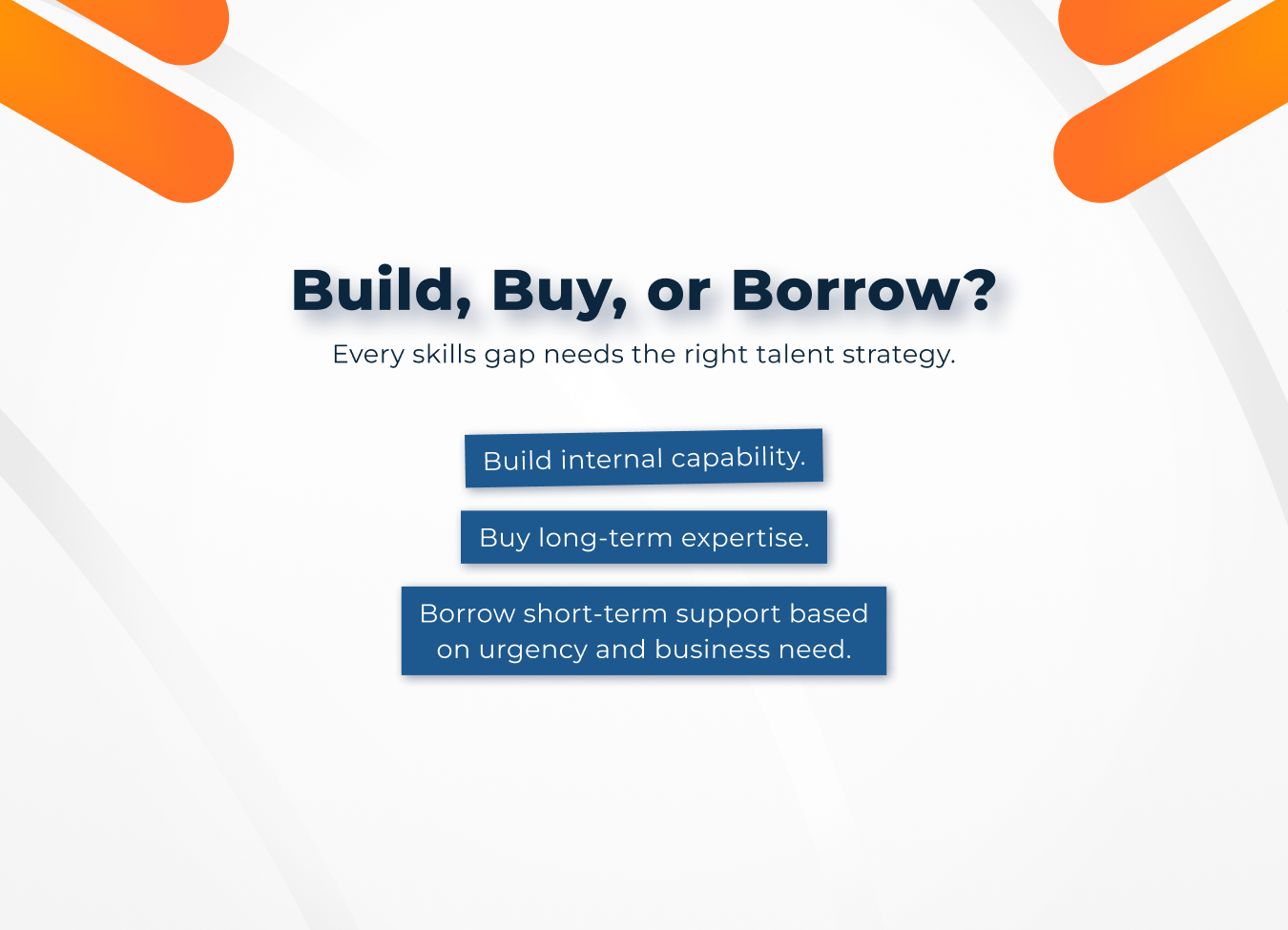
Every skills gap raises the same question: should the company develop this capability internally, hire someone who already has it, or bring in outside support to cover it? Most growing companies answer that question by instinct, usually defaulting to whatever worked last time. A more useful approach treats it as a real decision, with three distinct options and different trade-offs attached to each.
Build: Developing Talent Internally
Building means investing in the people already on the team — training, mentoring, stretch assignments, formal development programs. SHRM describes building as developing current talent through training, education, job rotation, and action learning, and notes that the right strategy depends heavily on the organization and industry rather than a one-size-fits-all answer.
Build works well when the timeline allows for it and the skill in question is one the business will need long-term. It tends to fail when a company tries to build under time pressure, expecting a skills gap that needs filling now to close through a training program that takes months to show results.
Buy: Hiring Externally for a Direct, Permanent Role
Buying means recruiting the capability from outside the organization — someone who already has the skill, brought on as a permanent, direct hire. This is the fastest way to bring proven capability into a specific, ongoing role, particularly for specialized or leadership positions where the cost of a slow internal build is too high.
The trade-off is competition and cost. In-demand skills draw competing offers, and a rushed external search often produces a worse fit than a properly vetted one. Our overview of the 2026 hiring playbook covers why partnering with a recruiting specialist for direct hires shortens that search without cutting corners on fit.
Borrow: Contractors and Short-Term Outside Support
Borrowing covers freelancers, consultants, and contractors brought in for defined, often temporary needs — a project with a clear end date, a specialized skill needed briefly, or work that doesn't justify a permanent role. It offers flexibility that build and buy don't, since the commitment scales down as easily as it scales up.
That flexibility comes with real limits. Contractor relationships typically involve less institutional knowledge transfer, more turnover, and less investment in long-term fit than a permanent hire. Borrowing solves a short-term capacity problem well; it's a weaker fit for a capability the business will need on an ongoing basis, since the relationship isn't built for continuity.
How to Decide Which Lever Fits
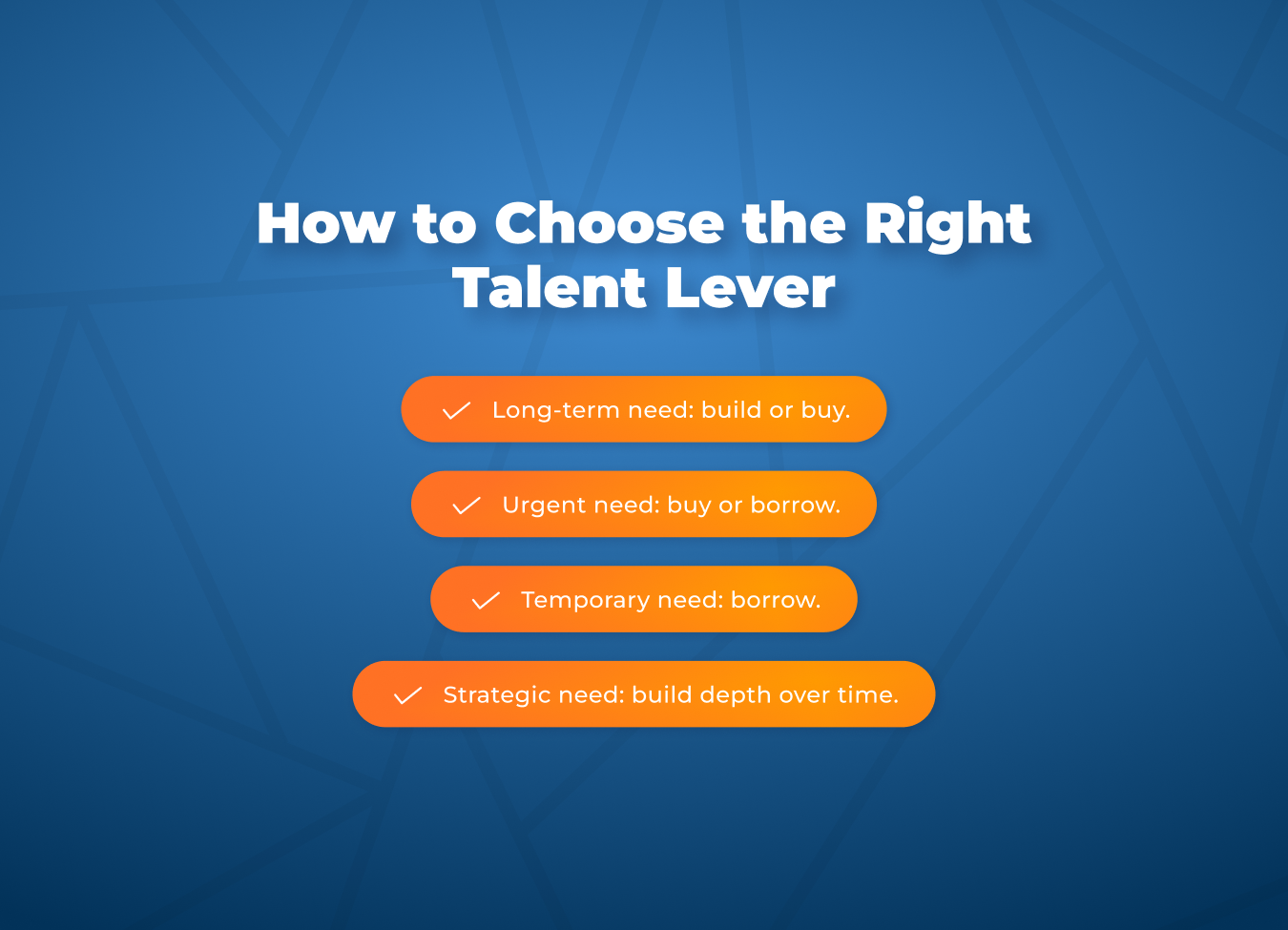
The decision usually comes down to two questions: how urgent is the need, and how long will the capability actually be needed. A skill the business will rely on indefinitely calls for build or buy, since both create lasting capability inside the organization. A need that's genuinely temporary is where borrowing fits best. Time pressure narrows the choice further — building takes the longest, buying moves faster, and short-term outside support moves fastest of all, but only for work that doesn't need to outlast the engagement.
Recent hiring data adds a caution to the "buy" side specifically. Deloitte's 2025 Global Human Capital Trends research found that two-thirds of managers and executives said their most recent hires weren't fully prepared for the role, with experience being the most common gap. Buying talent solves the skills question; it doesn't automatically solve the experience question, which is exactly where structured vetting matters most.
Where Long-Term Hiring Fits Into the Framework
For growing companies, the strongest position usually combines build and buy rather than leaning entirely on one. Internal development builds depth over time, while external hiring support helps fill gaps the business will carry long term. Through remote staffing, we handle the full process, including sourcing, vetting, onboarding coordination, payroll, and ongoing support for remote professionals. Through headhunting, we help companies find and interview qualified candidates for remote or onsite roles, while the client manages payroll, onboarding, and the direct employment relationship. Our overview of long-term staffing partnerships covers how an ongoing recruiting relationship supports sustained hiring needs, rather than treating every talent gap as a one-off transaction.
Frequently Asked Questions
What does the build, buy, or borrow talent framework mean?
It's a way of deciding how to close a skills gap: build develops existing employees, buy hires externally for a permanent role, and borrow brings in contractors or consultants for defined, temporary needs.
When should a company buy talent instead of building it?
When the skill is needed relatively quickly, or when developing it internally would take longer than the business can reasonably wait.
Is borrowing talent a good long-term strategy?
It works well for genuinely temporary needs, but it isn't designed for capabilities a business will rely on indefinitely, since contractor relationships typically involve less continuity and institutional investment.
How does a staffing partner fit into this framework?
A staffing partner focused on long-term placements supports the "buy" side of the framework directly, helping companies find and vet permanent hires for roles they'll need to fill on an ongoing basis.
Build a Hiring Process That Supports Growth
Closing a skills gap the right way starts with knowing which lever actually fits the need. Projective Staffing helps growing companies make confident, long-term hiring decisions, whether that's a specialized direct hire or a remote professional built into the team for the long haul. Get in touch to talk through your next hire.