
Key-Person Dependency: What Happens When One Person Holds Too Much
Every company has one. The person who's the only one who really understands the billing system, the only one the biggest client will talk to, the only one who knows why a process works the way it does. It feels like a strength until that person takes a vacation, gets sick, or leaves — and the business finds out how much was quietly resting on one set of shoulders.
What Key-Person Dependency Actually Looks Like
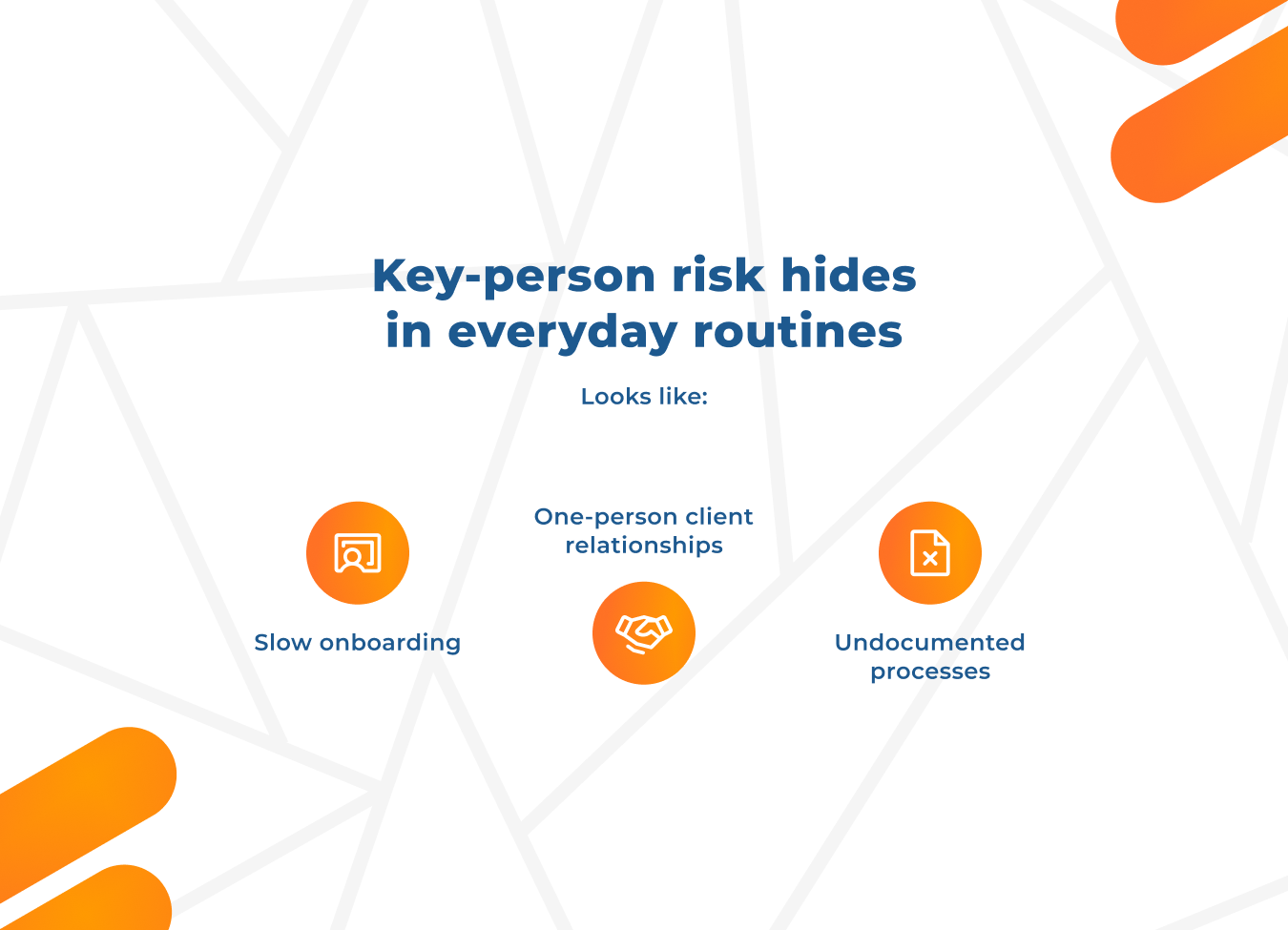
It rarely announces itself. It shows up as a new hire who takes months to get productive because everything has to be explained by one specific colleague. It shows up as a client relationship that exists entirely in one person's head, with no documentation of history, preferences, or context anyone else could pick up. It shows up as a process that runs fine every day, until the one person who understands it is unavailable and no one else knows where to start.
None of this is really about talent. It's about concentration. A company can have excellent people and still be dangerously exposed if critical knowledge, relationships, or decision-making authority sit with only one or two individuals and nowhere else.
Why It's More Common Than Most Leaders Realize
This risk tends to be underestimated because it's invisible until it isn't. SHRM's research on succession planning points out that middle managers and people leaders routinely hold critical, often undocumented knowledge — vendor relationships, workaround solutions, the reasoning behind past decisions — that traditional succession plans overlook because they focus almost entirely on the C-suite. Only about a third of CHROs surveyed said developing succession plans below the top executive level was a current priority, which leaves a wide gap between where the risk actually sits and where companies are planning for it.
Growing companies are especially exposed. As a business scales quickly, one capable person often absorbs responsibility for a function faster than the company builds a second layer of support around it — a structural gap that can look like recognition of skill, but isn't.
The Hidden Cost of Concentrated Knowledge
The exposure has a real cost, even before anyone leaves. A significant share of a typical worker's time goes toward searching for internal information or tracking down colleagues who hold it — time that gets spent because the knowledge exists in someone's head or an old message thread rather than anywhere accessible. That drag is constant, not just a risk that materializes when someone departs.
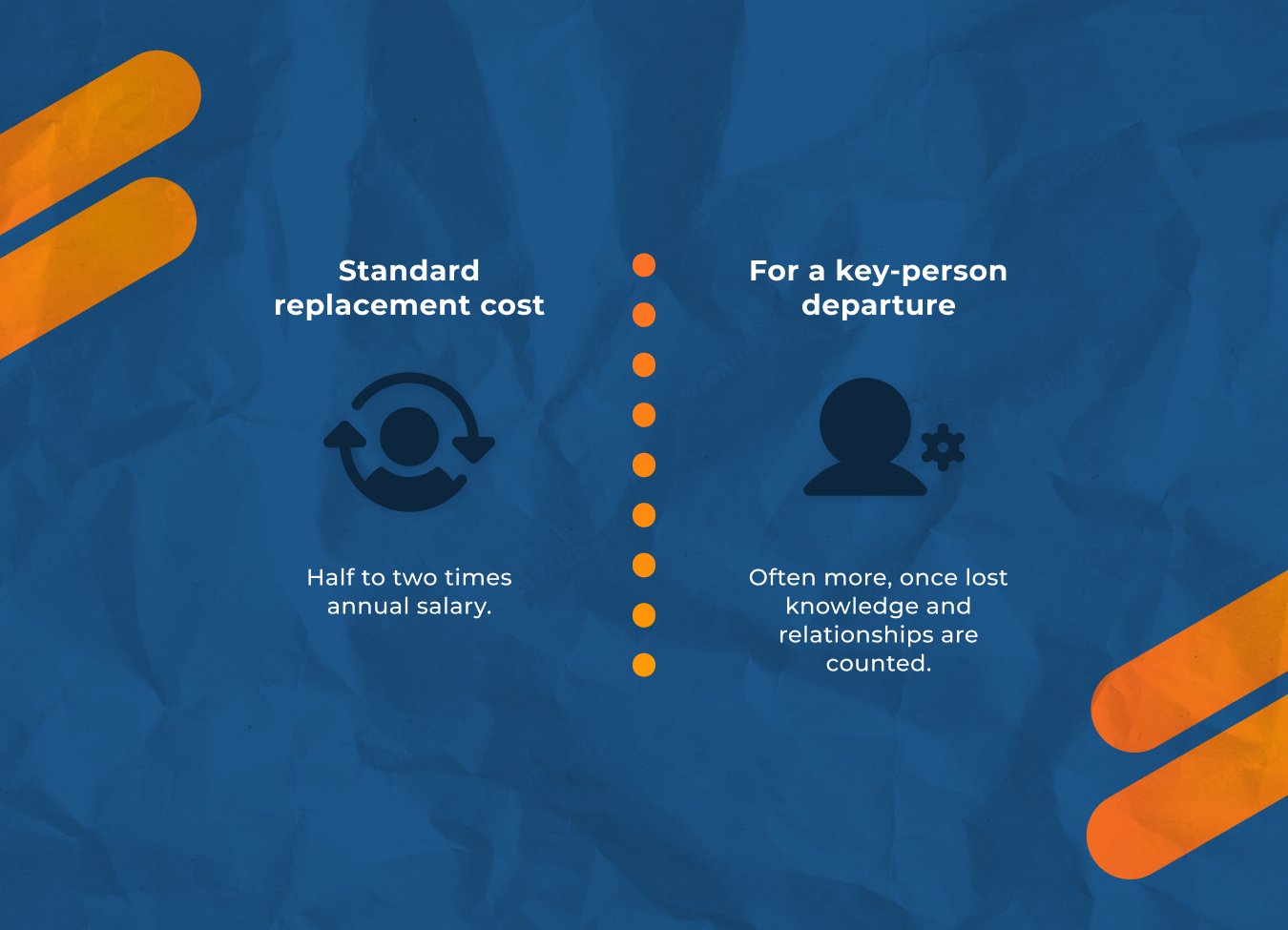
The departure itself compounds it. Replacing an employee conservatively costs between half and two times their annual salary — and that estimate doesn't account for the added disruption when the person leaving also happens to be the one holding relationships or knowledge no one else has. For a key-person departure specifically, the standard cost estimate is usually the floor, not the ceiling.
How Hiring and Structure Reduce the Exposure
The fix isn't asking one person to document everything in their spare time; it's building enough structural redundancy that no single departure creates a crisis. That means documenting processes as a normal part of how work gets done, not as an afterthought, and cross-training so more than one person can step into a critical function if needed.
Hiring plays a direct role here too. Bringing on additional support for a function that currently rests on one person spreads both the workload and the risk. Our piece on expanding a remote team globally covers how building out a function with more than a single point of failure works in practice, particularly for companies that have grown around one or two indispensable people by necessity rather than design.
This is also where an ongoing staffing relationship pays off, rather than a one-time hire made reactively after a departure already hurt the business. Our overview of long-term staffing partnerships covers how a continuous relationship with a staffing partner helps companies build depth into critical roles before a single person's absence becomes an emergency.
Frequently Asked Questions
What is key-person dependency risk?
It's the operational exposure a company faces when critical knowledge, relationships, or decision-making authority are concentrated in one or two individuals rather than distributed across a team or documented process.
How can a company tell if it has key-person dependency?
A common sign is a new hire needing months to become productive because they can only learn from one specific colleague, or a client relationship that exists only in one person's memory rather than shared records.
Does documentation alone solve key-person dependency?
It helps significantly, but documentation paired with cross-training and enough staffing depth to cover critical functions addresses the risk more completely than documentation on its own.
How does hiring reduce key-person dependency risk?
Adding support to a function that currently rests on one person distributes both workload and institutional knowledge, so a single departure doesn't leave the function exposed.
Find Remote Professionals Who Fit the Way Your Team Works
The strongest teams aren't the ones with one irreplaceable person — they're the ones with enough depth that no single departure puts the business at risk. Projective Staffing helps growing companies build that depth with the right long-term hires, remote and direct. Get in touch to talk through where your team could use the support.