
Remote Staffing vs. Headhunting in 2026: How to Choose the Right Hiring Model for Your Business
Hiring in 2026 is less about finding talent and more about choosing the right hiring model for the role, timeline, and level of ownership you want. If you’re comparing remote staffing vs. headhunting, you’re likely not asking which option is better, you’re asking which one makes sense right now. Both models solve different problems. This guide breaks down how each works, where each fits best, and how companies are using both strategically to build resilient teams without unnecessary friction.
Why Hiring Models Matter More Than Ever
Teams today are distributed, fast-moving, and increasingly specialized, with remote and hybrid work becoming more role-specific. At the same time, hiring mistakes are costly—showing up as delayed execution, operational overload, or early turnover.
That’s why the question in 2026 isn’t just who to hire, but how. Companies need staffing plans that align roles, timelines, and internal capacity, rather than relying on one-size-fits-all approaches.
Choosing between remote staffing and headhunting directly affects:
Speed to productivity.
Internal workload and ownership.
Cost structure and risk exposure.
Long-term flexibility.
Understanding these differences upfront helps companies avoid forcing the wrong hiring model onto the wrong role—and paying for it later.
What Headhunting Is
Headhunting is a targeted recruiting model. The focus is on identifying, engaging, and vetting candidates for a specific role. Once the hire is made, ownership fully transfers to the company.
Headhunting is best suited for:
Senior, leadership, or highly specialized roles.
Positions requiring deep company integration.
Onsite roles or fully owned remote hires.
Teams with internal HR and onboarding capacity.
In this model, the company controls employment, payroll, and long-term management. The value of headhunting lies in precision, finding the right person for a role where fit, experience, and alignment matter most.
What Remote Staffing Is
Remote staffing is an end-to-end hiring and employment model. Beyond sourcing and vetting, Projective Staffing supports onboarding, payroll, and ongoing administration.
Remote staffing is best suited for:
Operational, support, and execution-focused roles.
Teams that need to hire fast.
Companies scaling without global HR infrastructure.
Organizations looking to reduce administrative burden.
The emphasis here is speed and support. Remote staffing allows companies to add capacity without taking on the full operational complexity of international employment.
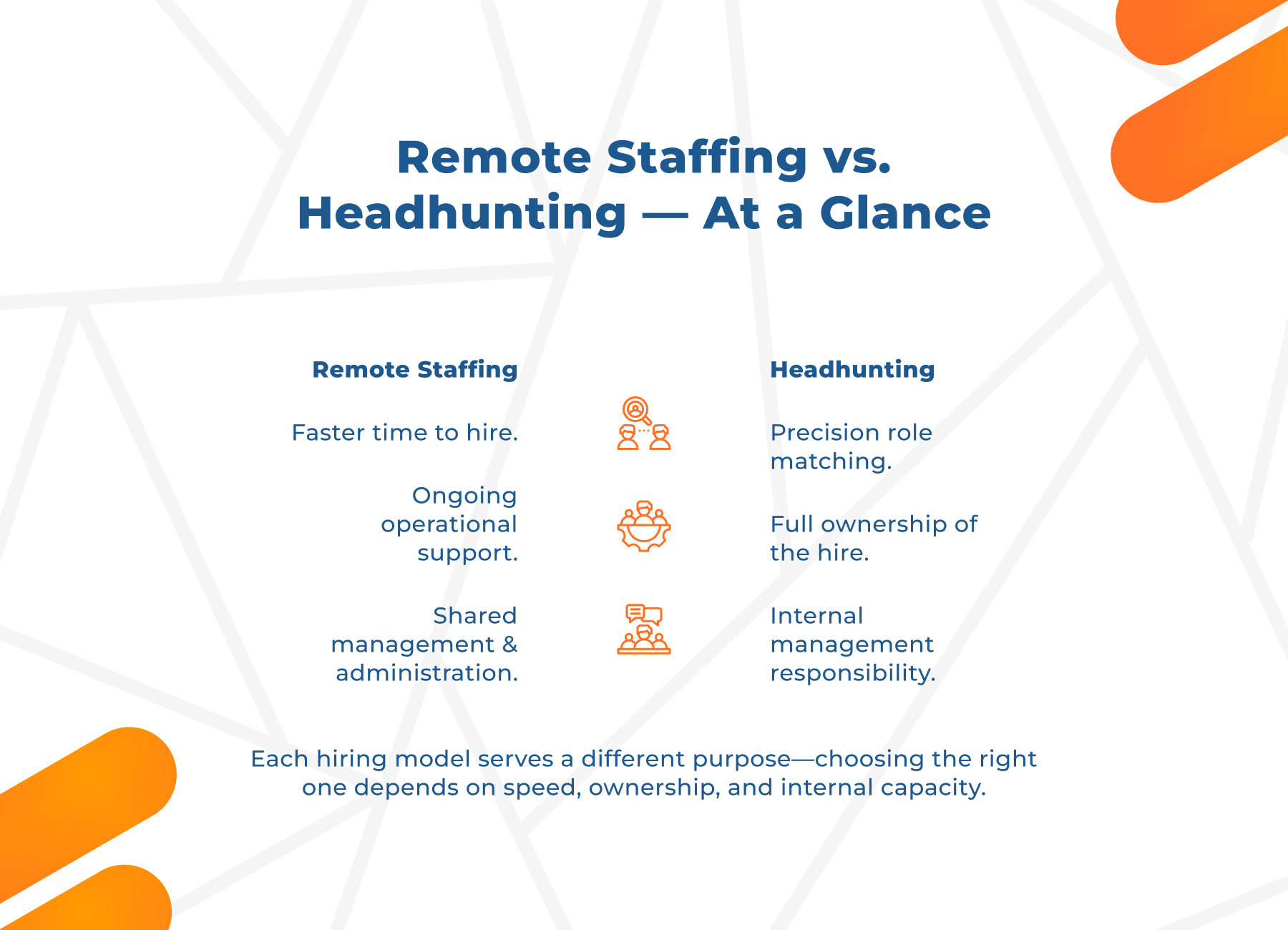
Remote Staffing vs. Headhunting: Key Differences That Matter
Speed vs. Precision
Remote staffing prioritizes speed and readiness.
Headhunting prioritizes depth, specificity, and long-term ownership.
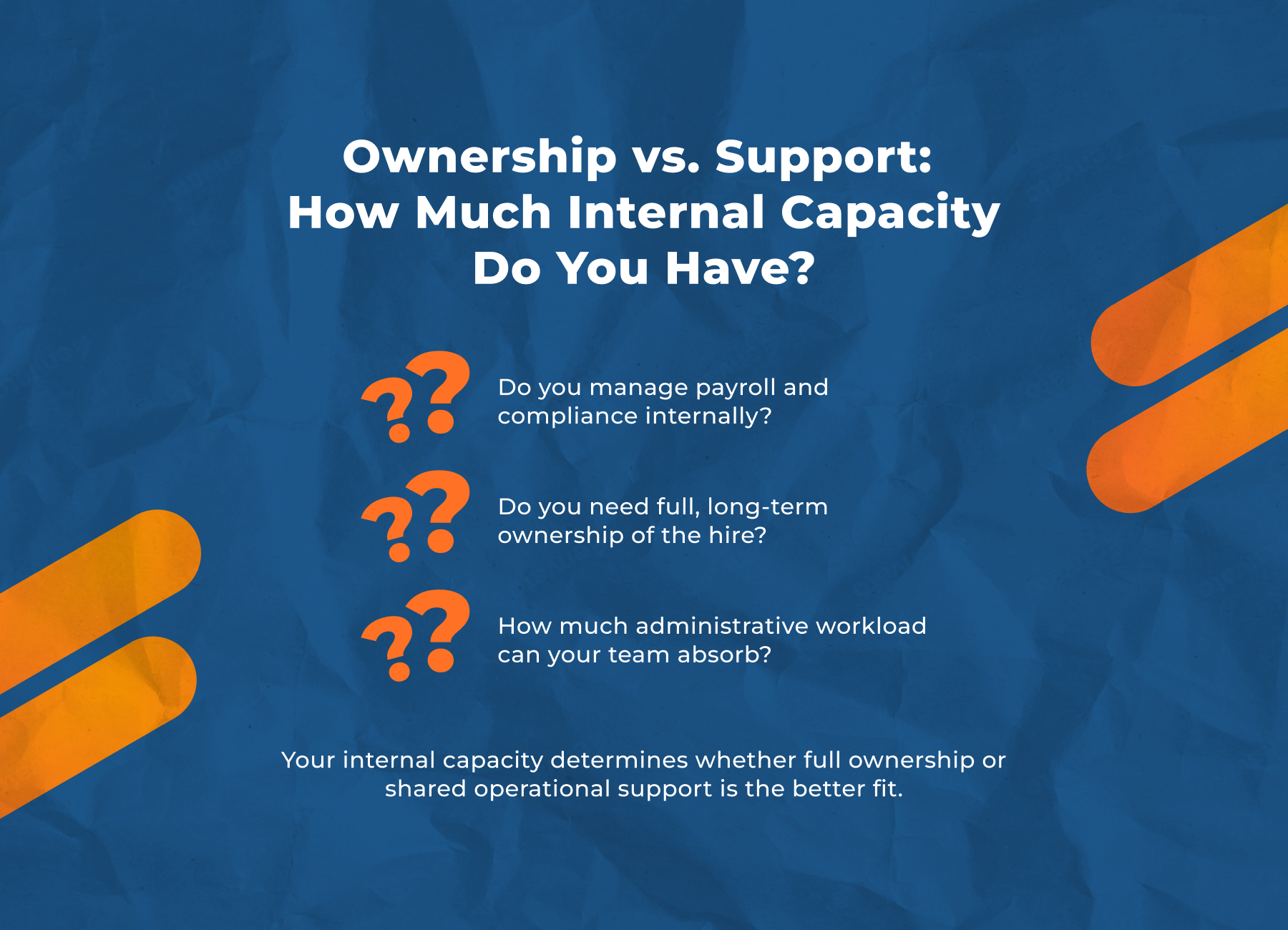
Ownership vs. Support
With headhunting, the company owns the hire completely.
With remote staffing, employment and administrative support are shared or handled externally.
Internal Workload
Headhunting requires internal HR, compliance, and payroll capacity.
Remote staffing reduces internal workload by design.
Neither model is inherently superior. The right choice depends on what you’re optimizing for.
How Projective Staffing Supports Both Hiring Models
Projective Staffing offers both remote staffing and headhunting, with clear boundaries between the two. The goal isn’t to push one model, it’s to help clients choose the right approach for each role.
With headhunting:
Focused, role-specific recruiting.
Deep vetting for experience and alignment.
Support through the hiring decision.
With remote staffing:
Pre-vetted professionals delivered in 3–5 days.
End-to-end support from sourcing to onboarding.
Ongoing payroll and compliance handled.
Hiring decisions at this level require a clear understanding of role complexity, ownership expectations, and risk—far beyond resume matching alone. This is why the value professional recruiters bring beyond resumes is essential when choosing the most effective hiring model.
Because both services sit under one roof, clients gain clarity rather than confusion. They receive guidance tailored to role requirements, urgency, and internal capacity, so each hiring decision supports the broader business strategy.
Frequently Asked Questions
What’s the difference between remote staffing and headhunting?
Headhunting focuses on recruiting only, while remote staffing includes ongoing employment and operational support.
Is remote staffing the same as outsourcing?
No. Remote staffing provides dedicated professionals who work as part of your team, not project-based outsourcing.
Which model is more cost-effective?
Cost depends on role type, urgency, and internal capacity. Each model is cost-effective when used in the right context.
Choosing the Right Model in 2026
Remote staffing and headhunting are not competing solutions, they’re complementary tools. The companies scaling effectively in 2026 are the ones that understand when to prioritize speed, when to prioritize control, and how to apply each hiring model accordingly.
If you’re evaluating which approach fits your next hire, Projective Staffing helps you make that decision with clarity, so you can build the team you need without unnecessary tradeoffs. Schedule a consultation today.