Seamless Remote Onboarding: From Job Offer to Day One
A smooth remote onboarding process is the difference between a hire who thrives, and one who drops off early. For remote teams, the move from hiring to onboarding is a make-or-break moment. It sets the tone for how well people stay, perform, and connect. Yet, many companies still treat onboarding as an afterthought instead of a strategic phase of remote team growth.
In this guide, you’ll learn how to turn a signed offer into a smooth path toward a productive, engaged remote employee.
Why Remote Onboarding Can’t Be an Afterthought
In remote work, the onboarding experience replaces the traditional first-week interactions, desk setups, team lunches, hallway conversations. Without intentional design, remote onboarding becomes scattered, confusing, or impersonal.
New hires who go through a structured onboarding process are 58% more likely to stay with a company for at least three years. A well-designed onboarding program can boost productivity by over 70%.
It’s not just about work culture, it’s about outcomes.
1. Build Continuity Between Hiring and Onboarding
Once a candidate accepts your offer, the experience shouldn’t go dark until Day One. The best companies begin onboarding the moment the offer is signed:
Send a welcome packet with key documents and what to expect.
Share a timeline of Day 1–Day 30 milestones.
Introduce the team via video, email, or Slack threads.
Assign a buddy or mentor to connect before the start date.
This flow continuity ensures the new hire enters with clarity, energy, and connection.
2. Automate the Admin, Humanize the Experience
Remote teams are increasingly using onboarding software to automate tasks like:
E-signatures and tax form collection
Account and tool setup
Compliance checks
While administrative tasks are part of the process, modern onboarding should go far beyond paperwork. By leveraging technology to streamline repetitive tasks, HR teams can dedicate more time to what truly drives long-term success: building meaningful relationships, offering mentorship, setting clear goals, and having real conversations that foster engagement from day one.
Staffing partners can handle the documentation, training logistics, and scheduling. This frees your team to focus on building human connections.
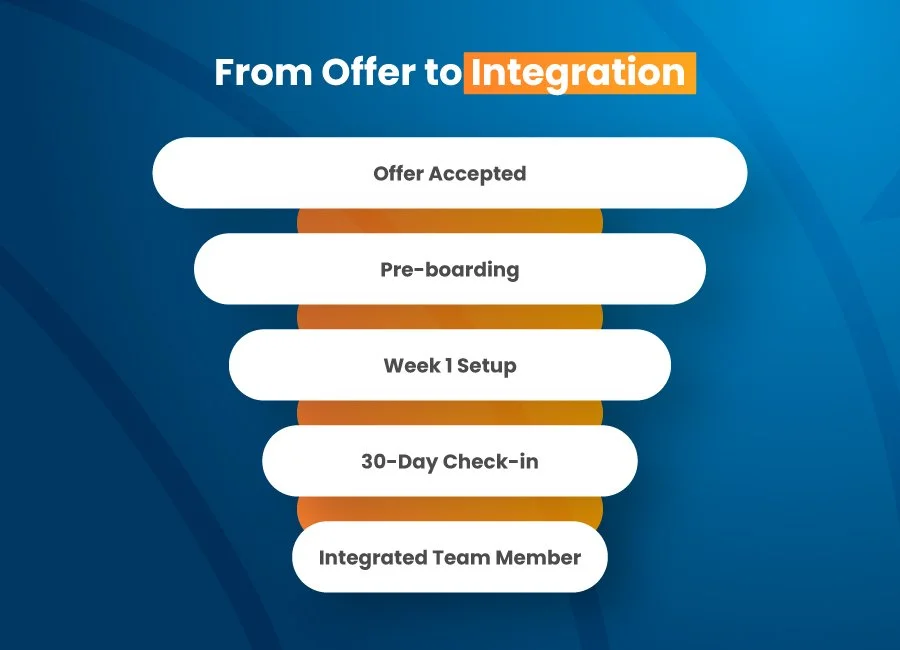
Timeline showing steps from job offer acceptance to first day for remote employees
3. Use a 30-60-90 Day Structure
A clear plan helps new hires ramp up faster. Top-performing companies often use a structured 30-60-90 onboarding model in order to reduce the risk of early termination:
First 30 Days: Work culture, tools, and foundational training.
Next 30 Days: Real projects, paired work, and feedback loops.
Final 30 Days: Ownership, reflection, and development planning.
4. Support Belonging and Connection Remotely
One of the biggest onboarding challenges in remote teams is loneliness. Without deliberate effort, new hires may feel isolated, especially if they’re working across time zones or joining established teams. Fostering a strong sense of belonging from day one is essential to retention and performance.
Create rituals that support social integration:
Host virtual welcome sessions or team AMAs.
Use Slack intros or spotlight threads to build visibility.
Schedule informal check-ins, not just task updates.
Assign a buddy for the first 60–90 days.
Culture doesn’t vanish in distributed teams, in fact, remote environments demand more thoughtful practices around connection, communication, and shared values. A strong remote culture helps new hires feel seen and supported, even from a distance.
5. Measure and Improve
Don’t “set and forget” your onboarding. Use feedback surveys at 30, 60, and 90 days to find gaps and optimize.
Track these KPIs:
Time-to-productivity
Early-stage turnover
Training completion rates
Onboarding satisfaction
These metrics are especially important for remote teams where visibility is lower and early struggles may go unnoticed.
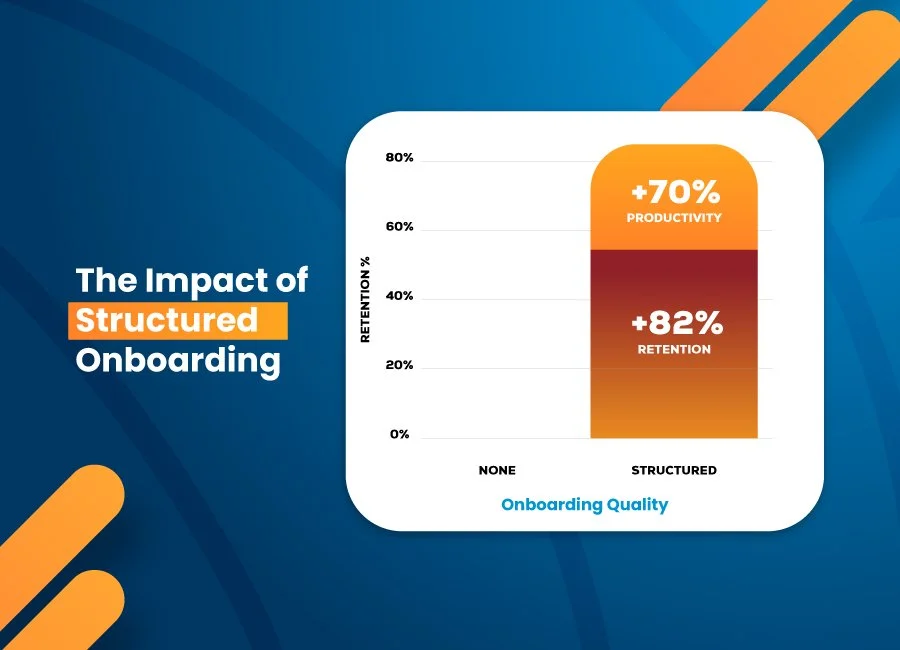
Bar chart comparing structured vs unstructured onboarding showing 82% increase in employee retention and 70% boost in productivity with structured onboarding programs
The ROI of Investing in Onboarding
Strong onboarding isn’t just good for morale, it’s a bottom-line advantage. Companies with structured onboarding processes improve new hire retention by up to 82% and boost productivity by over 70%.
These gains come from more than completing paperwork faster. Effective onboarding aligns new hires with business goals, accelerates time-to-productivity, and reduces costly turnover.
When organizations build long-term staffing partnerships, the onboarding process becomes more consistent, culturally attuned, and performance-driven.
FAQs: Remote Onboarding Process
What is a remote onboarding process?
A remote onboarding process is the structured approach companies use to welcome and integrate new hires into a distributed or work-from-home environment. It includes training, tool access, cultural onboarding, and support systems, all designed to ensure new members can thrive remotely.
How long should remote onboarding last?
While initial onboarding typically spans 30–90 days, ongoing support is key. The first 30 days should focus on work culture and tools, the next 30 on projects and feedback, and the final 30 on ownership and growth planning.
What tools are best for remote onboarding?
Key tools include digital signature platforms (like DocuSign), collaboration tools (Slack, Zoom, Asana), and LMS platforms for training content.
How do you make remote onboarding more engaging?
Use live welcome calls, assign mentors, create virtual team intros, and personalize the experience with custom training paths. Gamification, interactive videos, and real-time feedback also help boost engagement.
Why do companies partner with staffing agencies for onboarding?
Staffing partners help streamline the process, from documentation to Day One setup, ensuring consistency, compliance, and a better experience for new hires. They free up internal HR teams to focus on work culture and engagement.
We Help You Onboard Remotely, The Right Way
At Projective Staffing, we don’t just place talent, we support them after the offer. Our remote onboarding solutions help you:
Pre-board new hires with clarity and momentum.
Deliver consistent, branded onboarding experiences.
Match members with mentors for faster team integration.
Avoid early-stage drop-off by improving team fit from Day One
Whether you’re hiring your first remote professional or scaling globally, we’re here to help you build an onboarding process that drives retention and long-term success. Schedule a free consultation.